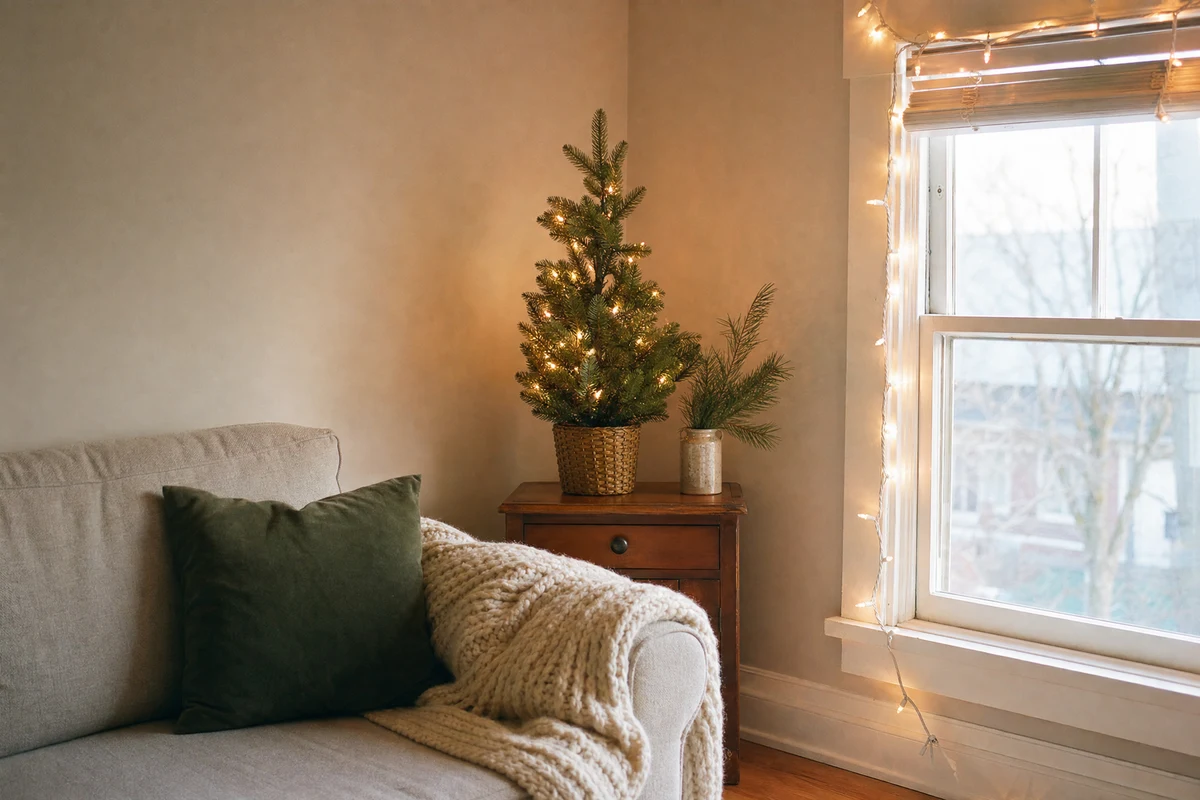
In a small apartment, December is easy and January is the problem. Everything you buy has to live somewhere for the other eleven months. Here are the real volumes: four pieces fit comfortably in one standard 27-gallon tote, and a full-size tree’s storage bag alone is bigger than the whole tote. That’s the decision, and it’s worth making before you shop.
The actual numbers
A standard 27-gallon Christmas tote measures about 31 by 21 by 14 inches, which works out to 5.2 cubic feet. That’s the container most people mean by “the Christmas bin.”
It does not go under a bed. Standard bed frames give 6 to 7 inches of clearance and a 14-inch tote needs double that. Under-bed storage means a slim bin at roughly 33 by 16 by 4.5 inches, or 1.4 cubic feet, which holds lights and textiles and nothing bulky.
Bed risers change that arithmetic, and decorating articles never mention them. They add 6 to 12 inches for about ten dollars, taking a 7-inch gap to 13 or more and putting a real tote in play. Measure your clearance, subtract an inch so the bin doesn’t scrape the slats, and shop to that number.
Roughly what each piece takes, packed:
- 100-count light strand: about a fist, call it 0.05 cubic feet.
- 9-foot faux garland: around 1.5 cubic feet compressed, close to a bed pillow. The bulky one.
- 22 to 26 inch tabletop tree: around 1.5 cubic feet with the branches folded.
- A throw and two pillow covers: half a cubic foot, folded flat.
Those are estimates from the packed size of typical products, not spec-sheet figures, but they total about 3.5 cubic feet — comfortably inside a 5.2-cubic-foot tote with room left for ornaments.
Swap the tabletop tree for a 6- or 7-foot one and its bag is about 48 by 19 by 14 inches, or 7.4 cubic feet. That single item is larger than the entire tote, and it lives on a closet floor all year.
Piece one: light
Lights do more per cubic inch than anything else you can buy, and a 100-count strand packs down to nothing.
Buy warm white, and shop by the words rather than a number. Christmas light packaging usually prints “warm white” or “cool white” and no Kelvin figure at all. Where a box does list one, 2700K to 3000K is the warm end, and cool-white Christmas strands sit far higher, which is the blue cast that makes greenery look grey.
Placement matters more in a small room than quantity. Along the top of a window frame, across a bookshelf edge, or around a doorway all look deliberate. Draped over a curtain rod looks like a dorm.
For anything mounted to walls, the no-nails guide covers load ratings and the one-hour adhesive rule.
Piece two: greenery, in one place
One run of greenery. Not five. A small room gets cluttered fast, and concentrating the seasonal material in a single spot is the fix.
Put it on the surface people look at when they walk in: a console, a bookshelf, the top of a low cabinet.
Real cedar and fir is worth considering for a storage reason, which is that it takes none. Tree lots will often give away the boughs trimmed off the bottom of trees. The trade is honest: no storage cost, but cedar browns and sheds in about a week in dry heated air and fir holds two to three weeks, so real greenery suits the back half of December instead of the whole month.
Faux garland is the bulkiest thing in the plan, at roughly a bed pillow’s worth of tote. Buy one.
Piece three: the tree, which is the whole decision
Everything above fits in a tote whatever you choose. The tree decides whether you also need closet space.
A tabletop tree at 22 to 26 inches on an 8- to 10-inch base sits on a side table, uses no floor, and packs into about a cubic foot and a half. On lights: the familiar “100 per vertical foot” figure is a full-size-tree rule that doesn’t scale down, because what it really tracks is branch surface area. A 2-foot tabletop tree wants something like 50 lights. Two hundred would be fifty-odd feet of wire on a two-foot object.
A full 6- to 7-foot tree costs the 7.4-cubic-foot bag year-round plus a two- to three-foot floor footprint through the season. That footprint is about 7 square feet. Against 450 square feet it sounds trivial, and the truthful version is that it isn’t a percentage problem: a small apartment has maybe two usable corners, and the tree takes one of them for six weeks.
The third option is no tree. A bare branch in a heavy vase with a few ornaments on it, or a stack of books with lights and greenery on top. Both store in almost nothing.
Real trees need the lease checked first, since plenty of buildings prohibit them, and a waterproof tray under the stand.
Piece four: textiles, and buy covers
Textiles do the warmth the other three can’t, and they’re where small-space storage quietly goes wrong.
Buy pillow covers, not whole pillows. A cover folds flat into an envelope. A whole pillow is a permanent object that has to live somewhere all year. Swap covers onto the inserts you already own and the inserts never move.
One throw over the sofa arm or the end of the bed does the rest. Cream, deep green, rust, or a plaid. Together they’re about half a cubic foot.
What the four leave out
No village scene, no themed dish set, no seasonal doormat, no wreath on every door. Each one is bulky, single-purpose, and stored eleven months for about six weeks of use.
Candles are the exception worth making, since they’re consumed instead of stored and scent carries further in a small room. The usual fire rules apply everywhere: never leave one burning unattended, and keep them clear of greenery, real or faux.
Packing it so next December is easier
Wind light strands in a loose figure-eight or onto a reel. Winding tight around a rigid card stresses the solder joints, and the real gain is that a flat pack doesn’t tangle and stacks, which is usable volume rather than less volume.
Ornaments need rigid dividers, and dividers need depth. Egg-carton style trays run 3 to 4 inches per layer, so a 4.5-inch under-bed bin gives you exactly one layer. Glass ornaments wrapped loose in fabric and slid under a bed for eleven months come out as fragments.
Label the tote on the end that faces out. Under a bed or on a closet shelf, that’s the only side you’ll ever see.
Small-apartment Christmas questions
What size tree for a studio? A 22- to 26-inch tabletop tree on furniture. A pencil tree is narrow but still 6 to 7 feet tall, so it carries a full-size storage bag and belongs in the closet-space conversation.
How many lights for a small tree? Around 50 for a 2-foot tabletop tree. The 100-per-foot rule is for full-size trees and badly over-lights a small one.
Will a Christmas tote fit under my bed? Not a standard 27-gallon one at 14 inches tall. Use a 4.5-inch slim bin for flat items, or add risers and gain 6 to 12 inches.
Where does a tree go in a studio? On a surface you already own, where the sightline from the door lands. Floor space is scarce; horizontal surfaces are free.
How do I stop it looking cluttered? Concentrate everything into one or two zones. In a small room, clutter is usually about distribution.
Measure the gap under your bed before buying anything. That number decides whether this is a one-tote Christmas or a closet-shelf one.