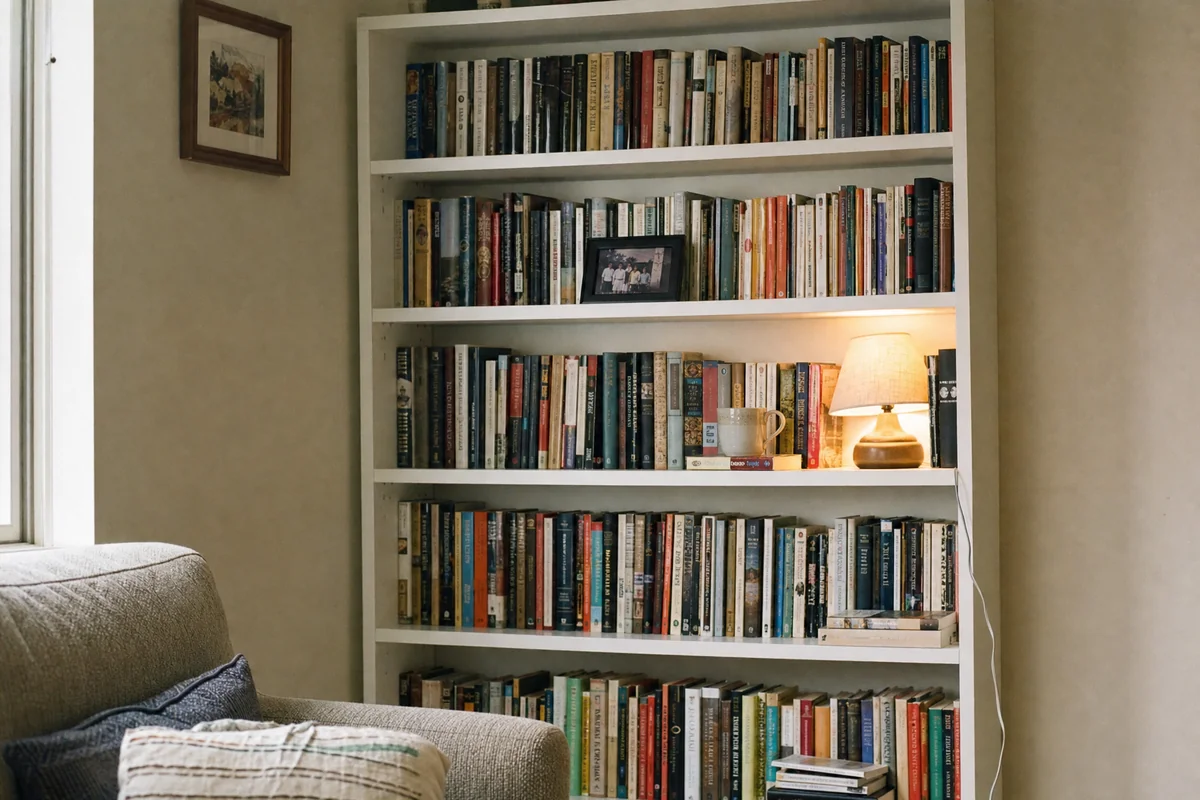
A Manhattan bookstore will sell you a foot of used hardcovers for $60, or a foot of fiction for $150, and stack it on your shelves for you. Bookshelf wealth costs less than that, because the definition requires the books to be ones you’ve read. The look is your own books, read, plus a couple of $2 and $4 frames leaned in front of them and a lamp and bulb on the shelf. If you own a bookcase, the whole thing costs about $55. If you don’t, add $43 for a Walmart one, so about $98.
What bookshelf wealth actually means
The term is from a TikTok posted in December 2023 by Kailee Blalock, who runs the San Diego design firm House of Hive with Taylor Troia. In Apartment Therapy’s write-up of the video, Blalock says the rooms “look cozy and lived-in” and are filled with “books that have actually been curated and read.” She calls it “a whole home vibe,” and she lists the rest of the kit: art stacked on the floor or hung in front of the shelves, a mismatched row of frames, a place to sit, patterns, task lighting.
By April 2024 the phrase was in the Cambridge Dictionary’s new-words blog, defined as shelves “filled with books and other objects they genuinely love, rather than displaying these things in order to look clever or stylish.” Color-sorted spines, sets of blank linen “books” and anything bought by the foot fail that definition.
Dwell’s take, in January 2024, was that none of this is new. It’s the library in every Nancy Meyers film, and it’s what people were doing with their Zoom backgrounds in 2020. Lisa White of the trend forecaster WGSN, quoted in that piece: “It is not about being able to buy and curate a look in one go.”
Shop your own house first
Before buying anything, spend twenty minutes collecting, because the trend is mostly a rearrangement.
Start with the books. Every one in the house goes to one place: the ones on the nightstand, the cookbooks, the paperbacks in the closet box, the college ones you kept. Don’t sort them by color. Bookshelf wealth shelves are the opposite of the styled shelf in the designer-ratios guide; there, Bobby Berk wants two-thirds books to one-third objects and 70/30 vertical to horizontal. Here the ratio is closer to all books. Fill the shelves nearly full, spines out, paperbacks mixed with hardcovers, some stacked flat where a run is short. Keep the dust jackets on. Berk pulls them off because cloth bindings look calm; Blalock’s rooms are the ones where you can read every title from the couch.
Frames are the second pile: every framed photo, print, kid drawing and diploma. The ones on the wall can stay, but the ones in drawers and closets are the raw material. In the GRT Architects apartment Dezeen used to illustrate the trend, the bookcase has “multicoloured books stacked in different directions against small sculptural objects,” and that describes most people’s junk drawer of frames once it’s on a shelf.
Small things last, and not many of them: a mug you don’t drink from, a ceramic bowl, a shell, a candle you’ve burned an inch of. Anything still in its box goes back in the closet.
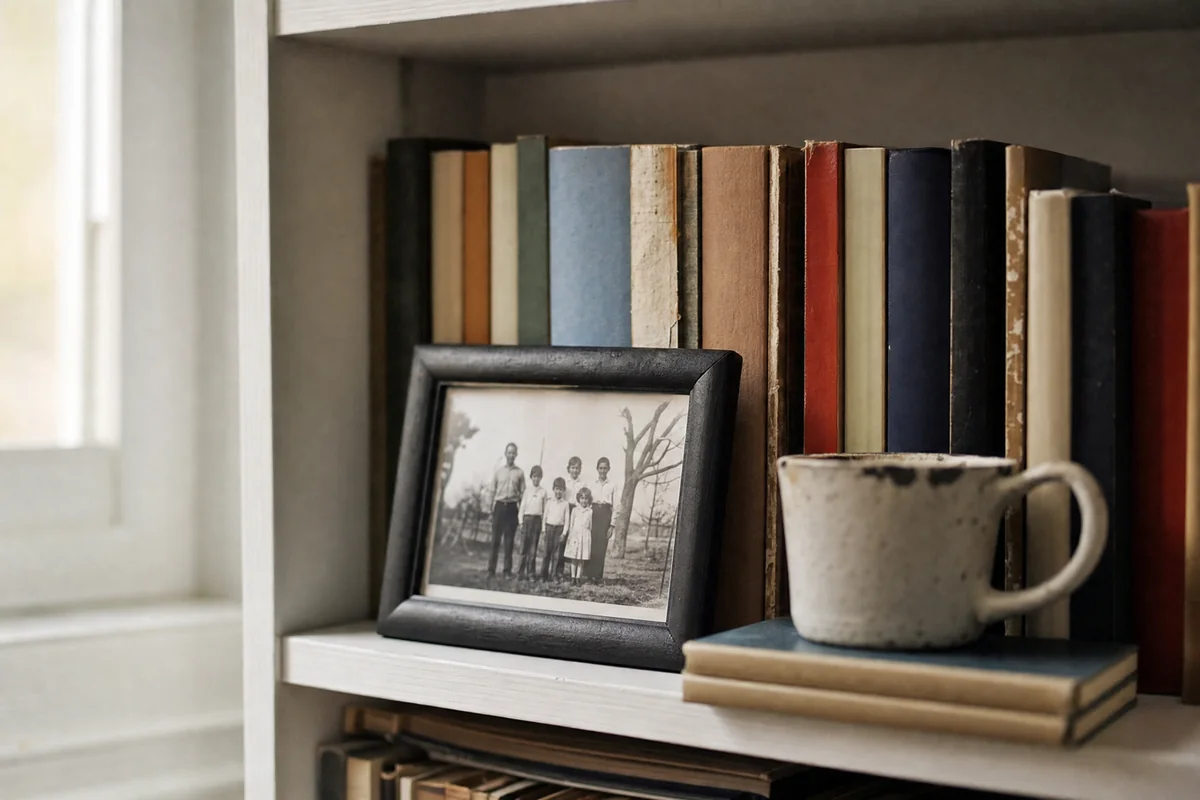
Now put the books in. Then lean the frames in front of them on two or three shelves, standing on the shelf edge, overlapping the spines by an inch. A leaned frame needs books behind it that are taller than the frame, so the small frames go in front of paperbacks and the 8x10s go on their side in front of hardcovers. Put one small object per shelf on a short stack of flat books, and stop.
The three things worth buying
A frame for something that isn’t art
Blalock’s art-in-front-of-the-books move is the cheapest signal in the trend and the one nobody’s shelf has by default. IKEA’s FISKBO frame is $1.99 in 4x6, $2.99 in 5x7 and $3.99 in 8x10 (priced September 5, 2026). Put a postcard in it, a page torn from an old atlas, a kid’s drawing, a photo of a grandparent. Lean it against the spines on a shelf you see from the couch. If you have a wall next to the bookcase, a $19.99 MOSSLANDA picture ledge from IKEA holds a 45-inch row of mismatched frames overlapping each other. It’s rated to 16.5 pounds, which is a row of small frames and not a row of glass-front 16x20s, and the two screws need a stud or drywall anchors.
The trend’s photos usually show a real painting hung on the face of the bookcase. A leaned frame needs no hardware.
A lamp on the shelf
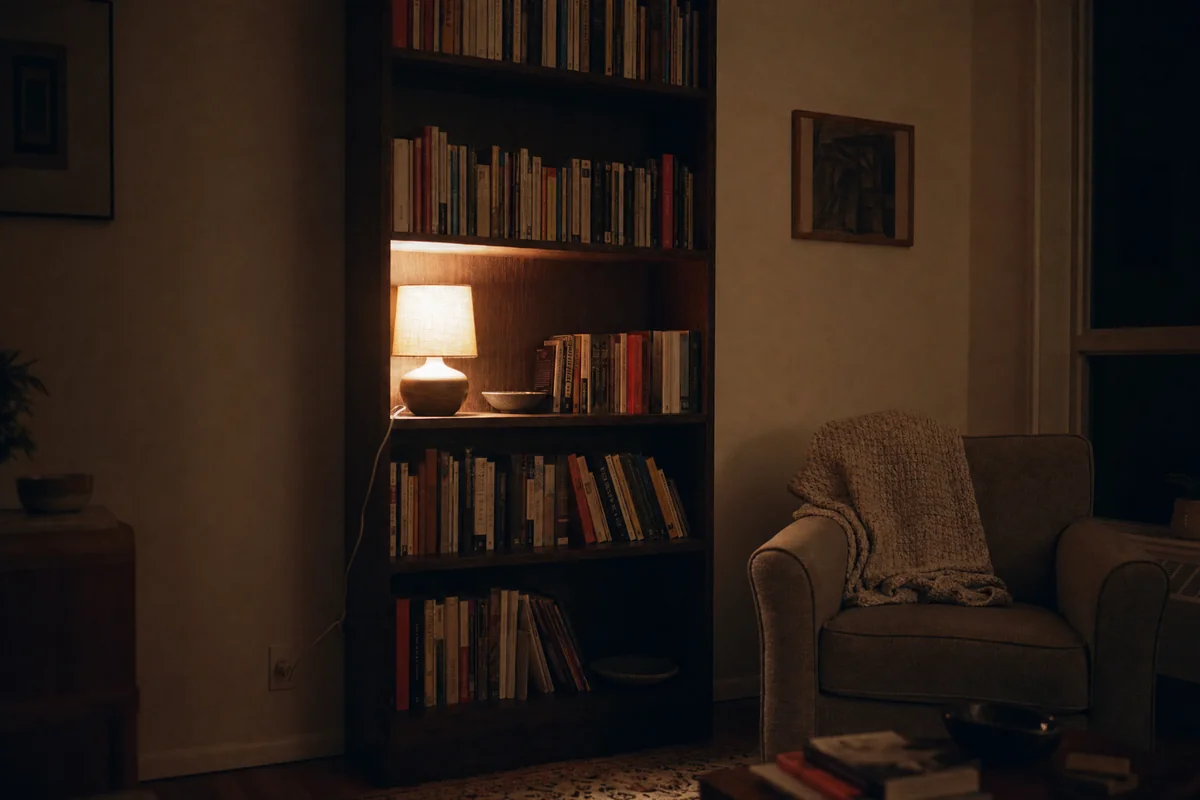
Task lighting is on Blalock’s list, and it’s the item that separates the trend from a bookcase with stuff on it. The reference rooms are lit low, from a lamp on or beside the shelves, and the photos are taken with the overhead light off.
IKEA’s TÄRNABY is $34.99, 10 inches tall, dimmable, and takes an E12 bulb that’s sold separately. IKEA’s dimmable SOLHETTA E12 is $7.99 for two, 2700K, which is the warm end; the $4.99 SOLHETTA two-pack isn’t dimmable, so the lamp’s dimmer would do nothing with it. Clear a shelf at about eye level when you’re sitting, raise the shelf above it a notch so the 10-inch lamp clears, and put the lamp toward the front. All three bookcases below have a back panel, so the cord comes down the side of the shelves to the outlet and you’ll see it. Put the lamp on whichever side of the bookcase is nearer the outlet, so the cord runs down one edge instead of across a shelf.
The bookcase, if you don’t have one
A tall IKEA BILLY is 31½ inches wide, 11 deep and 79½ tall: $84 in white, $89 in the oak effect. There’s also a compact BILLY, 31½ by 41¾ inches at the same 11-inch depth, at $49 in white. Walmart’s Mainstays 5-shelf in black oak is $42.77 and a good deal narrower, 24.88 by 11.65 by 71.42 inches, so measure the wall before picking on price. All three have adjustable shelves and a back panel. On the white BILLY the panel is worth painting: the GRT apartment’s bookcase has sienna backing panels, and painting the back of a bookcase a dark color is the cheapest version of the one-red-thing rule. The panel is coated fiberboard, so it wants a bonding primer before the color coat. Primer and a quart of paint are outside the totals below; expect about $20 to $30 at a hardware store. The Mainstays is already dark and doesn’t need it.
Skip the ladder-style shelves and the open-back cubes; neither fills edge to edge.
How long it’s supposed to take
The trend’s own writers keep saying the same thing: it accumulates. The idealhome.co.uk line Cambridge quoted calls it “playing the long game.” So the budget version has a schedule instead of a shopping list. The rearrangement takes an afternoon. After that, one book a month from a library sale or a used bookstore, read and shelved, and one frame every couple of months from a thrift store, where frames are the most underpriced category. In a year that’s about a dozen books and six frames.
What it costs
Prices checked September 5, 2026, on the product pages.
| Item | Where | Price |
|---|---|---|
| Books you own | your house | $0 |
| Frames you own | your closets | $0 |
| FISKBO 8x10 frame ×2 | IKEA | $7.98 |
| FISKBO 4x6 frame ×2 | IKEA | $3.98 |
| TÄRNABY table lamp | IKEA | $34.99 |
| SOLHETTA E12 dimmable LED bulb, 2700K, 2-pack | IKEA | $7.99 |
| MOSSLANDA 45¼” picture ledge, black (optional; add a few dollars for drywall anchors if there’s no stud) | IKEA | $19.99 |
| Total, bookcase you own | about $55, $75 with the ledge | |
| Mainstays 5-shelf bookcase, black oak | Walmart | $42.77 |
| BILLY 31½×79½, white ($89 in oak effect) | IKEA | $84.00 |
| Total with the Walmart bookcase | about $98 | |
| Total with the BILLY | about $139 |
What to skip
Books by the foot. Argosy Book Store in New York lists used general hardcovers at $60 a foot, fiction at $150, decorative cloth at $325 and antique leather from $500. For the tall BILLY’s six 31½-inch shelves, that’s about $945 of the cheapest tier before shipping. Dwell’s piece already had a commenter complaining that books were getting expensive because people were buying them for decoration.
Blank decorative “book” sets, the linen or paper-wrapped ones with no pages, sold in threes.
Color-blocking the spines.
A ladder leaned against a 6-foot bookcase.
Matching frames. The row Blalock describes is mismatched, so if you buy four FISKBOs, buy two sizes and put one in landscape.
Bookshelf wealth questions
Do I need a lot of books? Blalock’s rooms are full, but the definition is about whether the books are yours. With twenty, use the compact 41-inch BILLY ($49) or two shelves of a tall one, and fill the rest with the frames. With 500, the only job left is the lamp.
Can I do this with a rental bookcase or no wall access? Yes. The frames lean and the lamp sits; the only thing that goes into a wall is the optional ledge. In a rental, skip the ledge unless you’re fine patching two screw holes at move-out, and lean the extra frames on top of the bookcase instead.
Should the books be sorted? Not by color. Subject or size is fine, and so is no order at all, as long as you can find a book because you put it there.
Is this just maximalism? It overlaps. Dezeen’s lookbook filed it under “curated clutter,” and the designers and forecasters Dwell spoke to tied it to the end of pandemic decluttering. Maximalism has no rule about where the objects came from.
What if the bookcase is in a dark corner? Then the lamp comes first. Put it on the shelf at seated eye level, and if the corner is still dark, add a second small lamp on the floor beside the bookcase, pointed up.