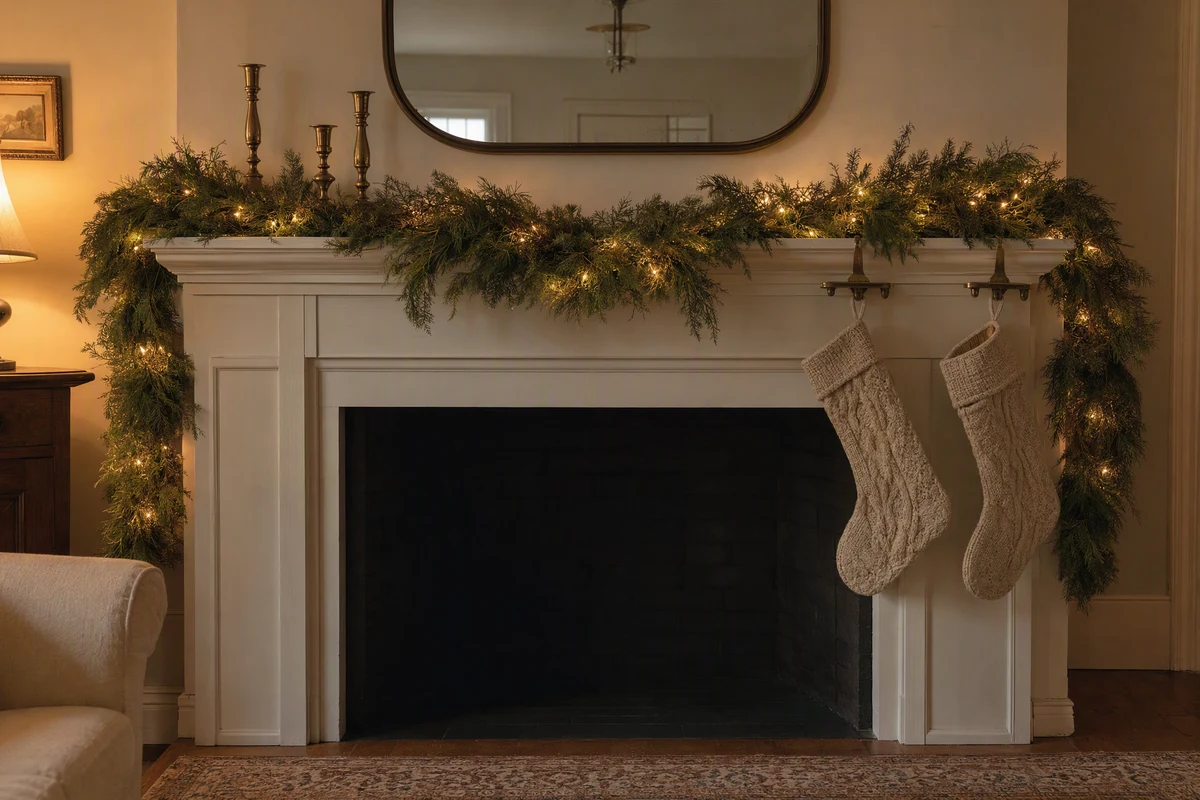
A mantel garland comes down to three decisions and one safety rule. Buy 1.5 to 2 times your mantel length. Get fullness by layering thin garlands rather than hunting for one thick one. Hang it on hardware that actually holds, which is the part most guides skip. And if you light fires in that fireplace, the garland does not stay up while you do.
How long
Measure the mantel and multiply by 1.5 to 2. A 5-foot mantel wants 7.5 to 10 feet, so a 9-foot length covers most people.
The extra length is the whole look. Garland pulled tight across a shelf looks like a stripe. What you want is a swag, a dip in the middle hanging lower than the two ends, plus tails falling at each end.
For a purely decorative fireplace, a lowest point 8 to 14 inches below the shelf looks right, and below that it starts to crowd the opening. If the firebox is ever lit, that figure is not yours to choose. See the clearance section below.
Two swags on a 5-foot mantel is a normal treatment, not a mistake. Deeper swags need more garland, so if you want two, buy at the top of the range or buy a second length.
How full
This is where money gets wasted. A garland that looks lush in a product photo rarely looks lush on a shelf, because the photo is lit to flatter it and your living room isn’t.
The fix is layering two or three inexpensive garlands into one run, twisted together and secured every foot or so. Mixed types beat matched ones: a pine base, cedar over it, a few eucalyptus or berry stems worked in.
Two things nobody tells you before you try it. Twisting shortens the finished run by roughly ten percent, so if you’re layering, buy at the long end of the length rule or you’ll lose your tails. And most faux garland has wire-cored stems, which means you can twist the branches of two garlands directly into each other and skip separate wire entirely. If you do want wire, 22- to 26-gauge floral paddle wire is the right range.
Then fluff it. Longer than feels reasonable. Faux garland ships compressed with every branch folded flat against the wire, and bending each one out to a different angle is a boring fifteen minutes that changes the result more than the price of the garland does.
Work in three dimensions while you’re at it. Branches should point out toward the room and up toward the ceiling, not only along the shelf. Flat-in-profile is the other reason cheap greenery looks cheap.
How to actually attach it
A layered garland with tails is heavier than it looks and a painted wood shelf is slick, so this is where mantels fail.
On a wood shelf, adhesive hooks mounted on the vertical face underneath the lip are the renter answer, spaced about every 18 inches with one at each end where the tails pull hardest. Load ratings, spacing and the one-hour set time are covered properly in the no-nails guide. If you own the place, small screw eyes on the underside are invisible and permanent.
On brick or stone, adhesive won’t hold. Brick clips that hook over the mortar edge cost a few dollars and need no drilling.
Two things that make the difference regardless of hardware: weight the tails with something at each end so the run doesn’t creep, and check your shelf depth before you commit. A 4-inch mantel will not carry a triple-layered garland plus candlesticks without one of them ending up on the hearth.
Fire clearance, which most mantel articles leave out
If your fireplace is decorative, skip this. If you burn anything in it, this section is the one that matters.
National fire codes require flammable material to sit at least 6 inches from the fireplace opening, and more depending on mantel overhang and material. The NFPA’s broader guidance is a 3-foot clear zone around a working fireplace for anything flammable.
In practice that means garland and stockings come off before you light a fire. Both dry evergreen and thin faux needles ignite readily, and a swag hanging 8 to 14 inches below the shelf is heading toward the opening rather than away from it. Plenty of people decorate a mantel they never light, which is fine. Deciding which one you have is the point.
If you want faux, look for greenery labeled flame-retardant, and use metal clips rather than plastic near any heat source.
How cheap
Premium pre-lit 9-foot garland runs $40 and up per length. Plain unlit garland from Walmart, Target, Michaels or Hobby Lobby costs a fraction of that, and craft-store greenery goes on deep discount repeatedly through the season, including well into December.
So layering is also the cheap route: two or three budget garlands wired into one run usually costs less than a single premium length and reads fuller than either. Buying unlit and adding your own light strand costs less again and gives you more control.
Free option worth knowing: tree lots often give away the boughs they trim off the bottoms of trees. It’s real greenery at no cost, and it stores nowhere because you throw it out in January.
Real greenery doesn’t all behave the same indoors. Cedar browns and drops within about a week in dry heated air. Fraser fir holds two to three weeks. Eucalyptus air-dries and stays presentable for months. Plan real material for the back stretch of December, or run faux as the base and tuck real stems in late.
Lights
Unlit garland plus a separate warm-white strand costs less than pre-lit and gives you more say in the result.
Shop by the words on the box. Christmas light packaging usually says “warm white” or “cool white” and never prints a Kelvin number; where one is listed, 2700K to 3000K is the warm end and cool-white strands run far higher, which is the blue cast that makes greenery look grey.
Weave the strand deep inside the garland instead of laying it on top, so you see glow rather than bulbs. A battery pack with a timer hides at one end and saves you reaching behind furniture twice a day.
The rest of the mantel
Garland is the horizontal. The mantel still needs a vertical, or it stays a stripe with objects on it: a mirror or piece of art above, candlesticks of varying heights grouped at one end, weighted to one side rather than matched at both.
Stockings hang from weighted mantel hangers that sit on top of the shelf, holding by their own mass, instead of from the garland. Hanging them off the garland puts their whole weight into the garland’s hardware. That’s how a mantel ends up on the floor on Christmas Eve.
No mantel at all? The shelf and ledge substitutes in the no-fireplace guide work the same way.
What to skip
Skip pre-lit garland with white cord. The cord reads clearly against green from across a room.
Skip filling every inch. Garland plus two or three other elements is the ceiling; add candles, stockings, ornaments, a village and framed cards and you have a shelf that has given up.
And skip buying one expensive garland to fix a sparse-looking mantel. The problem is usually length, fluffing and depth before it’s quality.
Mantel garland questions
How long should garland be for a 5-foot mantel? Seven and a half to 10 feet. Buy longer if you’re layering, since twisting costs you about ten percent.
How far should it hang down? Eight to 14 inches at the lowest point, for a fireplace you don’t light.
Can I hang garland over a working fireplace? Not while it’s lit. Codes require 6 inches minimum from the opening for flammable material, and the NFPA advises a 3-foot clear zone. Take it down before you light a fire.
How do I attach it without damaging the mantel? Adhesive hooks under the lip on wood, brick clips on masonry, screw eyes underneath if you own the house.
Real or faux? Faux as the base since it holds shape and stores. Real tucked in for the last couple of weeks, chosen by species: fir and eucalyptus last, cedar doesn’t.
Hang the hardware before you buy the greenery. It’s the step that decides whether the garland stays where you put it.