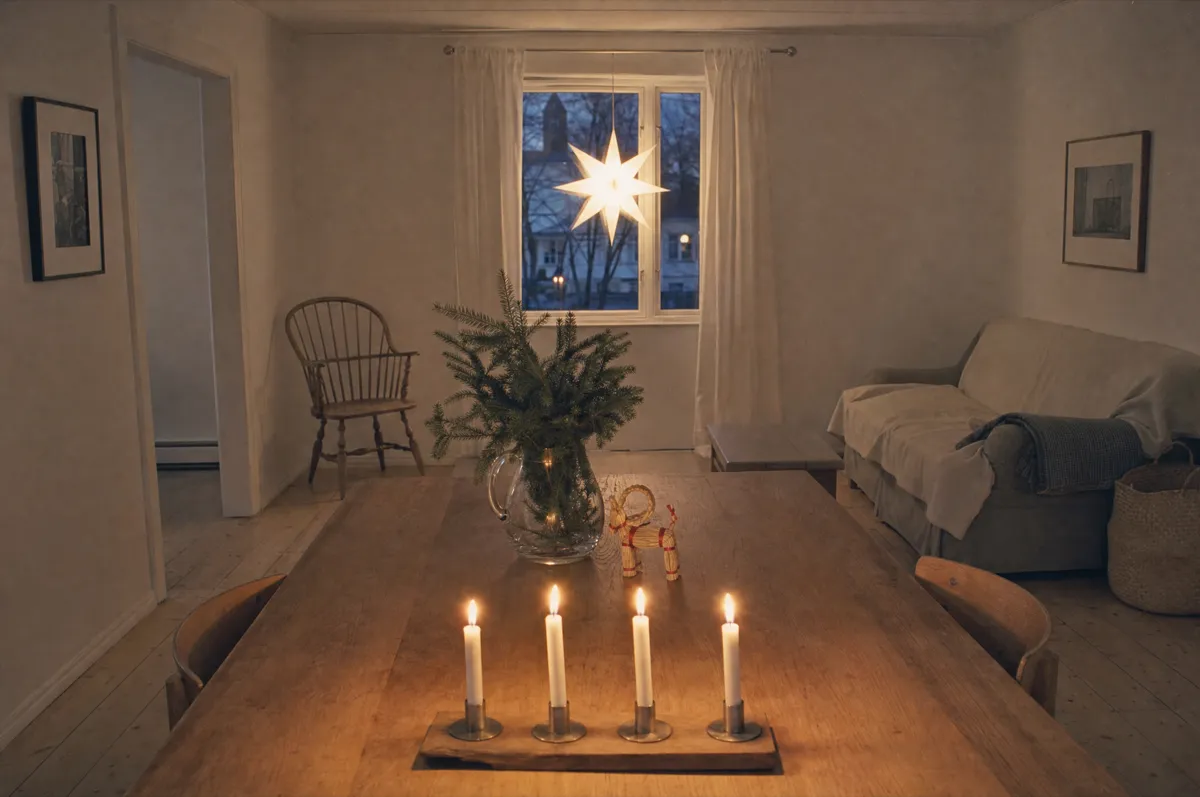
Scandinavian Christmas decor is a short list: one paper star lit in the window, real candles in plain holders, cut evergreen with nothing hung on it, and straw or wood where an American tree has glitter. At IKEA and Walmart prices the set is under $60. Most of the work is taking things out.
Start by taking things out
This step costs nothing. Box up the multicolored lights and the tinsel. Then anything with a word printed on it, the 24-count ornament set where every ball matches, the plaid throw. Anything glittered goes in the same box. What’s left in the room should be white and natural wood and green, with a little red.
The reason is the light. In Stockholm the sun sets around 2:50 in the afternoon on December 21. Copenhagen gets until about 3:40. Minneapolis still has daylight until about 4:35, and Boston until about 4:15. The Swedish and Danish December traditions grew up in rooms that were dark by mid-afternoon, and nearly all of them are about putting a small warm light somewhere.
The words printed on the throw pillows come from the same place. Hygge is Danish, mys is Swedish, koselig is Norwegian, and all three mean roughly “cozy” in the sense of a warm room with people in it.
The window star
If you buy one thing, it’s the star. A lit paper star hung in the front window is the one object that says Scandinavian from the sidewalk.
The star is older than Sweden’s use of it. It started as a geometry lesson at a Moravian church school in Niesky, in eastern Germany, in the early 1800s, and the town of Herrnhut has made them commercially since the 1880s and 1890s; the Herrnhut factory still does. Sweden picked it up in the 1920s and 30s, and in 1941 the man who later founded H&M started mass-producing a cheap cardboard version that put one in ordinary windows. It goes up on the first Sunday of Advent, which is November 29 this year, and comes down on January 13, the traditional end of the Swedish Christmas season.
Sweden’s other window light is the electric advent candelabra, seven small bulbs in a pyramid. A Philips employee in Gothenburg named Oskar Andersson had the idea in 1934, and the first 3,000 sold out when they went on sale in 1937. I looked on IKEA’s US site on September 2, and the only candelabra in the STRÅLA range this year is a red designer one at $39.99, not the plain seven-light kind, so the plain version means an import shop. The star does the same job from the street for $26.
IKEA’s STRÅLA paper shades are the cheap way in. The 28-inch lace-pattern white star is $7.99, and the cord set that lights it is $17.99, so a lit star is about $26. The cord is sold separately, and it is 157 inches long, about 13 feet, which reaches from the top of most windows to a baseboard outlet. Measure first if the nearest outlet is across the room. IKEA lists the shade at 9 ounces and the cord set at 8, so the hook has to carry about a pound. Use a Command medium clear hook, rated for two pounds, not the mini one rated for half; the medium is $4.49 for two at Target and the mini is $3.99 for six. It goes at the top of the window frame with no nail. Wipe the frame with rubbing alcohol first, press the strip for 30 seconds, and give it the full hour before hanging anything; the no-nails Christmas guide covers why the hour matters.
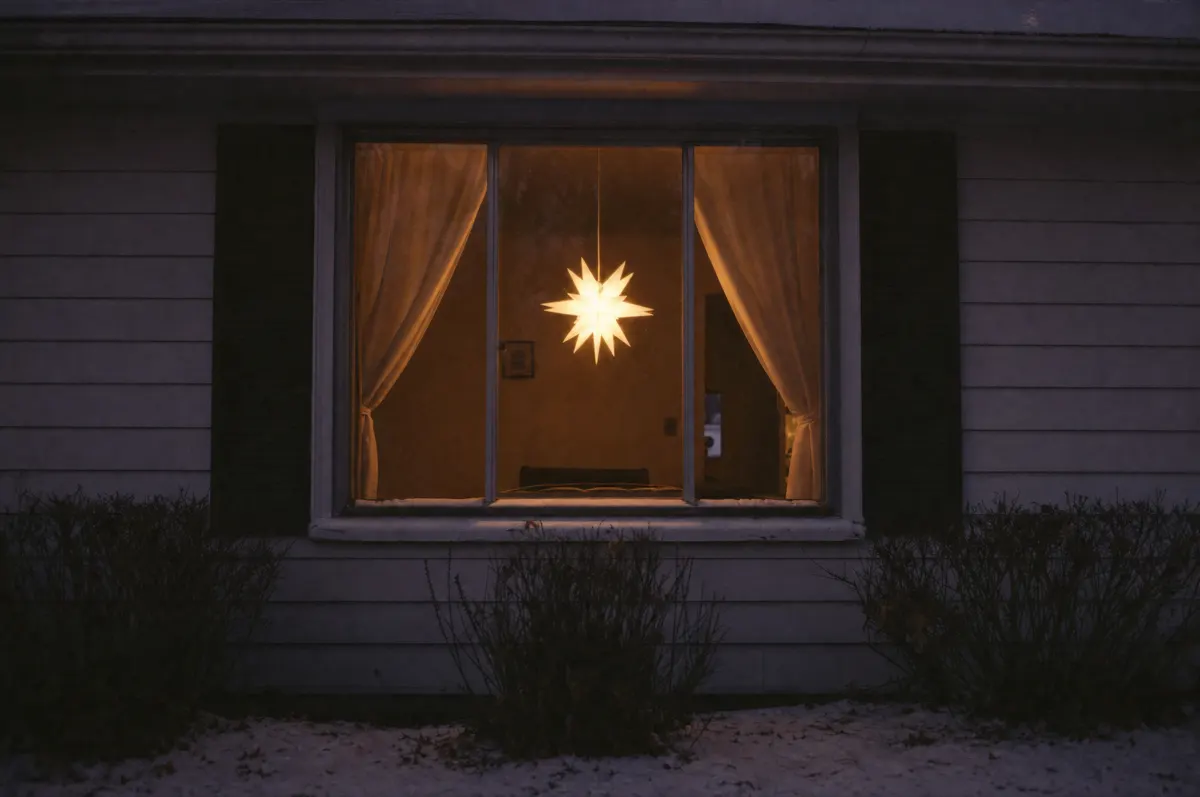
Hang it in the window that faces the street, centered, from a hook at the top of the frame. A 28-inch star’s center lands about a foot and a half down the glass, which is below the curtain rod line from outside. Put the cord on a $6 outlet timer. In Sweden the star is on from dark until bedtime.
Don’t put real candles in the window. The draft off cold glass pushes the flame toward the curtain.
Candles, and more than you’d normally put out
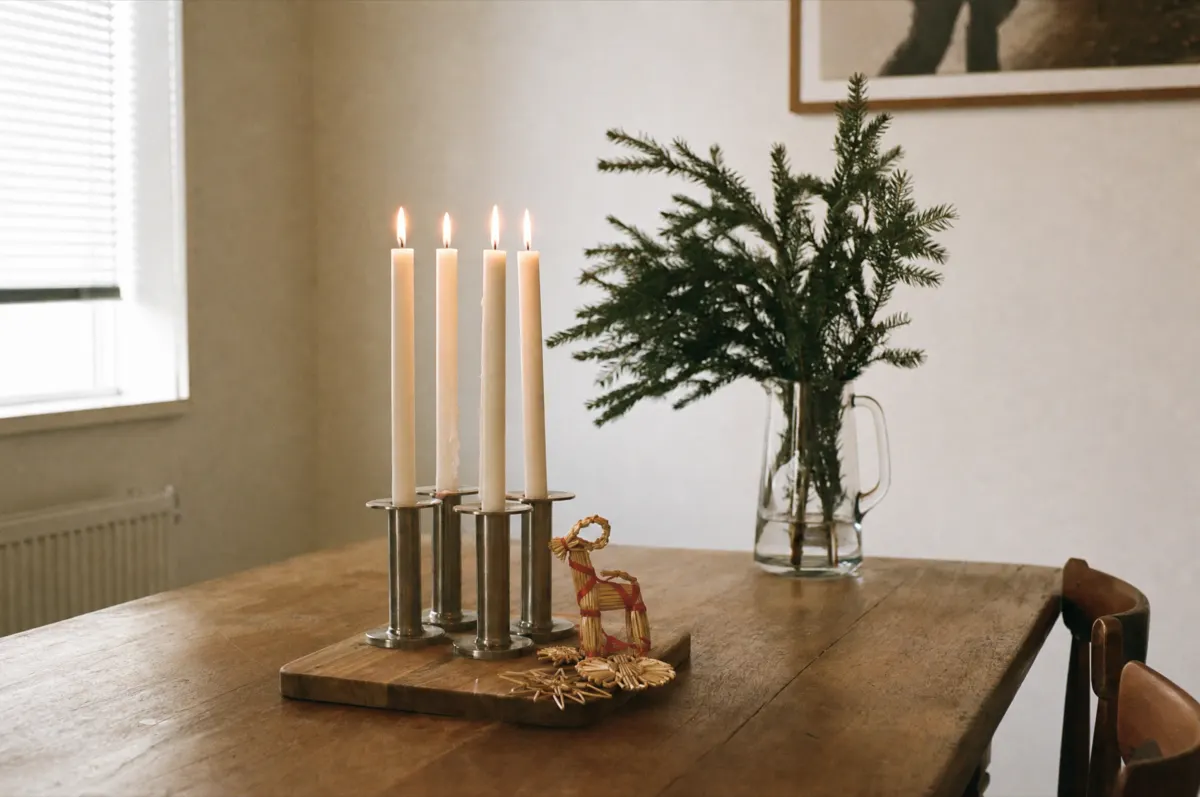
The tradition is live flame. The advent custom in Sweden and Denmark is four candles, and you light one more each Sunday, so by December 20 all four are burning at different heights. That only works with candles that last the month. IKEA’s FENOMEN set of five natural-colored blocks is $14.99, the blocks are rated between 20 and 40 hours depending on size, and four of them on a plate is the Danish version. A six-hour taper lit on the first Sunday is gone by the second.
For the everyday table, buy plain white unscented tapers. IKEA’s JUBLA is 20 candles for $14.99, each rated at six hours, and Walmart’s Mainstays 10-inch tapers are $3.62 for four. Skip scented candles entirely for this; the look is the flame, and a cinnamon pillar is a different project. Tapers need a holder made for a three-quarter-inch candle; a tealight cup won’t hold one. IKEA’s SILVERPÄRON two-candle stick is $14.99, and one of those on a wooden board in the middle of the table is the centerpiece. If you want brass, IKEA’s STOCKHOLM holder pair is $29.99, and it’s a low, squat holder that takes a taper on one side, not the tall candlestick in the catalog photos.
NFPA’s candle page: a foot of clearance from anything that can burn, nothing hanging above the flame, and blow them out when you leave the room. NFPA’s candle fire report puts 11 percent of US home candle fires in December and another 11 percent in January, the two peak months, and almost three times the daily average on Christmas Day itself. Three in five start because something burnable was too close. The practical rule for this look is that candles live on the table and the greenery lives somewhere else. If they have to share a mantel, the garland guide has the clearance numbers.
Greenery with nothing on it
Cut branches in a jug of water. No ribbon, no ornaments, no lights wound through them.
Tree lots trim the bottom branches off the trees they sell. Ask; many hand the trimmings over free, and some charge a few dollars for a bundle. Fir holds longest indoors. A University of Georgia extension forester’s list runs from fastest-drying to slowest: red cedar, spruce, Leyland cypress, balsam fir, Fraser fir. So if the lot has a choice, take the fir trimmings and leave the cedar. Bend a needle before you take a branch; it should flex, and if it snaps the branch is already dry. Keep the jug away from heat vents and topped up with water, and plan on the branches looking good for a week or two in a heated room and longer if the room is cool.
A tree, if you want one, follows the same rule. Small, real, white lights or none, wooden or straw ornaments, nothing shiny. The small-apartment plan has the tree sizes and what each one costs you in storage the rest of the year.
Straw, wood and paper where the glitter would go
Straw ornaments are the Swedish answer to glass balls, and they’re cheap. Scandinavian import shops sell sets from about $11 for 25 pieces to $19 for 45: stars, angels, hearts and snowflakes. The julbock, the straw goat, comes in the bigger sets or on its own.
Get the goat. It predates the Christmas tree in Sweden; the straw goat was the gift-bringer in the 1800s before the tomte took over, and it’s still a standard piece on a Swedish Christmas table, tied with a red ribbon. The city of Gävle has built a giant one every December since 1966, and in more than 40 of those 60 years someone has burned it or knocked it down.
Paper snowflakes cut from printer paper and taped to the inside of a window are free, they’re traditional, and a kid can make a dozen in an afternoon.
Wood beads do the garland job. One strand draped loosely on a shelf or around a small tree is plenty. Target.com lists a Kurt Adler 9-foot natural wood bead garland at about $18.
The color rule
White, wood and green, with red in one place. The red goes on the goat’s ribbon, or one runner, or one set of candles, and only one of those.
What it costs, checked September 2
| Item | Where | Price |
|---|---|---|
| STRÅLA 28-inch paper star, white lace | IKEA | $7.99 |
| STRÅLA cord set | IKEA | $17.99 |
| Command medium clear hooks, 2 | Target | $4.49 |
| FENOMEN block candles, 5 | IKEA | $14.99 |
| Straw ornament set, about 25 pieces | import shop | $11 |
| Fir trimmings | tree lot | free |
Prices are what IKEA, Target and Walmart listed on September 2. That’s about $56. Adding the everyday tapers means the JUBLA pack and the SILVERPÄRON holder, another $30, for about $86; with two packs of Walmart tapers in a holder you already own it’s about $63. The wood bead garland is another $18 on top of any of those.
IKEA’s holiday range went up on the US site the first week of September, and seasonal stock doesn’t get reordered, so buy the star and the cord now. Tapers are stocked all year. Fir trimmings don’t exist until tree lots open around Thanksgiving.
What to skip
Throws and pillows with “hygge” printed on them.
Faux fur on every surface. One sheepskin over a chair back is plenty.
Black-and-white buffalo check. It gets sold as Nordic, but it’s American farmhouse and it fights the star.
A second star. One per street-facing window is the look, and one for the whole house is fine.
Fairy lights in mason jars, or any battery light standing in for a candle.
Scandinavian Christmas questions
Is Scandinavian Christmas the same as minimalist? Close, but it isn’t empty. A Swedish December table is crowded with candles, straw, and food. The restraint is in color and material, not in quantity.
Is it all white? No. Traditional Swedish Christmas is red and white; the all-white version is a design-magazine and Instagram development. Both are right. They’re different rooms, so don’t mix them.
Where do I get a paper star? IKEA, under STRÅLA, from early September. Buy the cord set at the same time.
Do the candles have to be real? For the look, yes. The point is a flame in a dark room. If real candles aren’t allowed where you live, one warm-white LED block per plate is the compromise, and skip the flickering ones.
Does it work in a rental? Better than most Christmas styles. The star hangs on one adhesive hook, the candles sit on the table, the branches sit in a jug, and nothing goes on a wall.
Buy the star and the cord first, this month, before either sells out. Everything else in this list is on shelves in December.