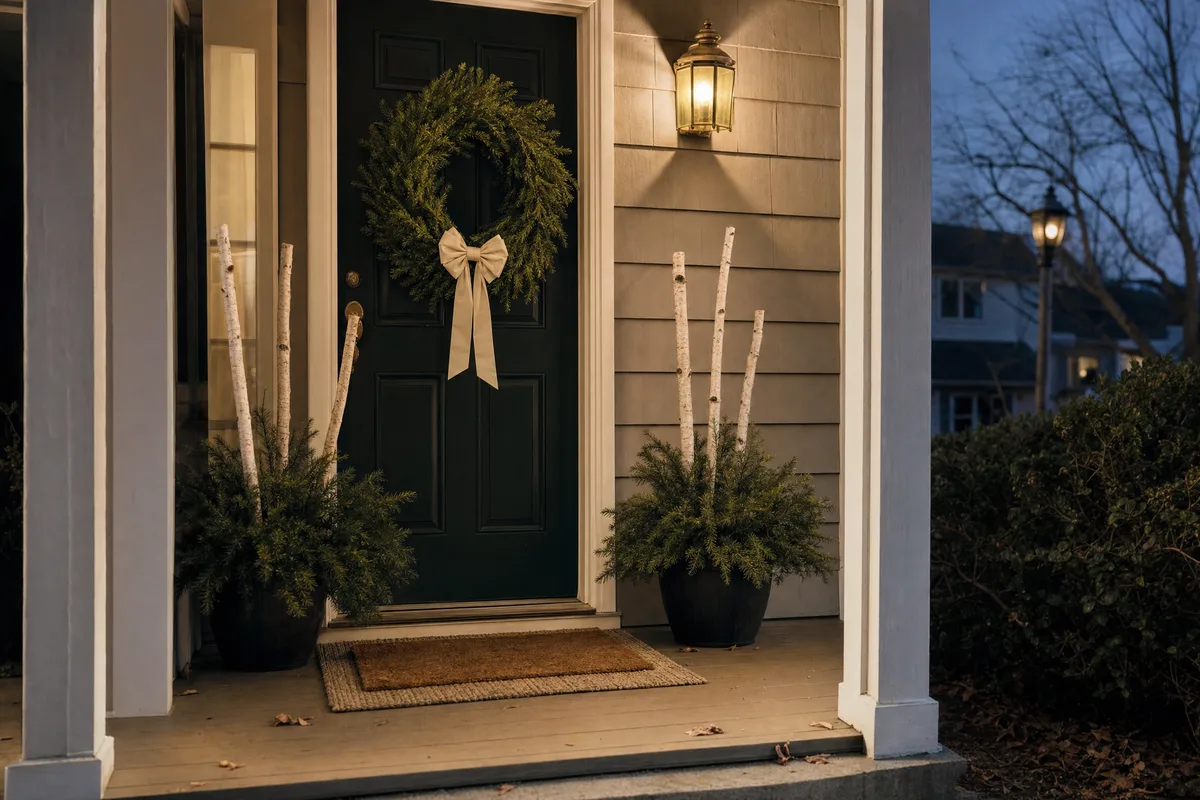
In mid-December the sun is down by about 4:30 in New York, 4:20 in Chicago and a quarter to five in Los Angeles, so most of the people who see your porch see it in the dark. Without string lights, that means a wreath big enough to read from the street, a pale bow and pale objects against a dark door, two planters beside the door for scale, and a warm bulb in the porch light you already own.
Who sees the porch, and when
Neighbors walking the dog after work. The delivery driver at 7 PM. You, pulling in. Atlanta keeps its light until about 5:30 (timeanddate.com has the minute for any city), and even there the porch has no daylight audience after work.
String lights fix that by adding light. Without them you work with the porch fixture, a streetlight and passing headlights. Under that light, pale objects on a dark background show, big shapes show, shiny things show. Small ornaments and dark green on dark siding don’t.
The fixture comes first because it’s the cheapest thing to fix. If it takes a normal bulb, put a warm one in, and check the box for the Kelvin number rather than the marketing word: 2700K is the color of an old incandescent, per ENERGY STAR’s bulb guide, while “warm white” on some brands means 3000K or more. Most porch fixtures are enclosed and get rained on, so the box also needs to say it’s rated for enclosed fixtures and damp locations. Home Depot’s EcoSmart 2700K filament bulbs are about $9 for a two-pack.
Size the wreath to the door
For a standard 36-inch door, Balsam Hill’s sizing guide puts the right wreath at 24 to 30 inches, and a professional wreath maker’s rule is door width minus 12, which gives you the smallest size that works: a 24-inch wreath with about 6 inches of door showing on each side. Above that, measure the flat panel of the door before you go to 30, because a 30-inch wreath leaves 3 inches a side and a bow on top of that.
Fresh or faux is a lifespan question. Lynch Creek Farm, which grows and ships fresh wreaths, says one lasts about 6 to 8 weeks outside in a cold climate and closer to 4 to 6 in a dry or southern one. Fir holds its needles best; Clemson’s extension service lists pine, fir and cedar as the slow driers and spruce as the fast one. Keep it out of direct sun. Misting the back helps, but only on days above freezing, unless you want an iced step in front of the door.
Price is where the size floor bites. The cheap fresh wreaths are 22 inches: Home Depot’s fresh 22-inch with a bow was $14.98 last season and Costco’s ran about $20. Costco’s 28-inch came as a two-pack for $69.99, so a fresh wreath that clears the 24-inch floor is closer to $35. Faux and unlit, Home Depot’s Northlight 24-inch pine was $16.99 and Walmart’s Holiday Time 24-inch was $15.26. At the size that works, faux is about $20 cheaper in year one and free after that. Fresh still wins on smell and up close. That matters more in a rental you’ll leave than on a door you’ll have for five more Christmases.
The bow is what makes either one show at night. A green wreath on a dark door at dusk has no edge. Wired ribbon in the 2.5-inch width is the right scale, and a bow with tails for a 30-inch wreath uses most of a 10-yard spool. Michaels sells 10-yard wired spools at about $10. Cheaper ones exist; check they aren’t sheer, which is too transparent to read from the sidewalk. Cream, oatmeal and red-and-white check all show. Solid red goes dark fast in dim light, so only use it where the fixture lights it directly. Sage, navy and burgundy disappear. Buy ribbon labeled outdoor or weather-resistant; craft satin isn’t made for rain.
Hanging depends on what the door is made of, and a fridge magnet tells you in ten seconds. If it sticks, the door is steel, and a magnetic hanger like Haute Decor’s Attract holds a 10-pound wreath for about $16. Wood or fiberglass means an over-the-door hanger, and Village Lighting’s is rated to 20 pounds at $35. Command’s outdoor large metal hook holds 5 pounds, can be applied down to 15°F, and needs a rubbing-alcohol wipe and the one-hour wait before loading that the no-nails Christmas guide covers. A wet 30-inch wreath in a gust pulls far harder than its weight on a scale, so an adhesive hook is for a 24-inch faux wreath and nothing bigger.
A storm door changes all of this. A full wreath is 4 to 8 inches deep and the gap behind a closed storm door is an inch or two, so the front door is out. Hang the wreath on the outside of the storm door instead, with a slim hanger made for storm doors; most frames are aluminum, which a magnet won’t grip. A suction hook on the glass works for a light faux wreath on clean, dry glass and for nothing heavier, because suction lets go in the cold. Or skip the door and hang it on the wall beside it, where it reads from the street just as well.
Put the second thing beside the door, not on it
The pots your mums died in are the right size for this, 12 to 14 inches, as long as they’re plastic or fiberglass. Terracotta and unglazed ceramic crack when wet soil freezes in them, and wet frozen soil is the plan.
Fill them with cut greenery. Home Depot sells five 24-inch incense cedar boughs for about $24 once tree season starts, and Christmas tree lots trim branches off the bottoms of trees all day; ask, and many will give them to you. Pack the soil down hard, water it, and push the stems in deep with the tallest in the center. Loose potting soil won’t hold a bough in wind. Packed wet soil will, and in a cold climate it freezes around the stems during cold snaps, which is the best anchor there is. Start before the pot has frozen solid, though, because then nothing goes in. In a warm climate push deeper and pack harder, since the freeze isn’t coming.
Then add height and pale color. From the street, tall pale things are what the eye finds first. The expensive version is white birch poles. Michaels sells 3-foot ones at about $62 for four, two per pot. They’re dried wood sold as indoor decor, so expect the bark to darken and lift where it sits in wet soil; push them in only a few inches, wire the pair together low down so they stand as one, and plan on one season. The cheap version is branches from your own yard, sprayed with a $6 can of flat white paint with the garage door open, before the cold arrives, because spray paint won’t cure on a cold, damp branch. Thin branches need more of them than poles do: five per pot, cut to different heights, standing a foot or two above the greenery.
If you’d rather buy one living thing, a 3-gallon dwarf Alberta spruce is about $43 at Home Depot and ships around 28 inches tall. It takes a bow at the top, and the nursery pot drops into the mum pot for size, weighted with gravel around it so it doesn’t blow over. Roots above ground get far less protection than roots in the ground, and this species browns in winter wind. In zone 6 and warmer, water it on days the soil isn’t frozen and plant it in spring. Colder than that, a potted one is a gamble. Two run about $86.
Skip the tiny planters. A pair of 8-inch pots beside a 36-inch door doesn’t show from the street in daylight and doesn’t exist after dark.
Use what’s already shiny
Most of the reflective stuff is already in the house. A brass or mercury-glass lantern beside the planter catches the porch light and passing headlights. It doesn’t have to hold anything.
Ornaments work if they’re big enough. The standard 24-count packs are 2.5-inch balls, $7 at Walmart to about $19 at Target and Home Depot, and 2.5 inches is invisible from the sidewalk. Four inches and up shows. Read the label: “shatterproof” means plastic, not weatherproof, and Target’s Northlight set says outright that it’s for indoor use. Look for “indoor/outdoor” before you wire three big ones into the wreath under the bow.
A battery lantern with a timer isn’t a string light, needs no outlet, and runs no cord under the door. Target’s 16-inch Threshold outdoor lantern is about $34 and runs on two AAs with a built-in timer; Walmart’s Better Homes and Gardens version with a removable LED candle is about $20. Use lithium AAs, since alkalines fade in the cold. If “without lights” for you means “without an outlet,” this is the one exception worth making. If it means no lights at all, skip it and lean harder on the pale bow and the white branches.
Contrast at the floor
A coir mat over a larger flat rug is the combination the fall porch guide starts with. A plain 24-by-36 coir mat is $13 to $17 at Walmart, and a 3-by-5 jute layering rug runs about $25 for a no-name and $32 to $47 for a nuLOOM. The rug has to be bigger than the mat, or there’s no border and no layer. Choose a pale mat or a light pattern; a dark red doormat on a dark porch floor is invisible after dark.
Jute is a fall material, though. It soaks up water and molds. On a covered porch it can stay down through December. On an exposed one, swap it for an outdoor-rated flatweave in the same size, or pull it and run the coir mat alone.
Wind, rain and the sidewalk
A no-lights porch is tall, light objects with nothing holding them down. Weight plastic pots with sand or gravel under the soil. Wire the tallest branches to each other low down so they move as a bundle. Assume anything on an open porch can walk off, so don’t put out a lantern you’d mind losing.
What it costs, and when to buy it
Prices are last season’s listings and will drift. Faux wreath, one spool of outdoor ribbon, two packs of boughs, a can of white spray paint and the warm bulb comes to about $90, reusing the mum pots and the fall rug. If the tree lot gives you the boughs, it’s about $42. One pack of birch poles instead of painted branches takes it to about $145. A 28-inch fresh wreath instead of faux adds about $20. The lantern is on top of all of that.
Faux wreaths and ribbon are on shelves in October; the good sizes sell down by mid-November. Fresh greenery and boughs arrive the week before Thanksgiving. Buy boughs then and a fresh wreath in the first days of December. By the third week of December the faux stock is half off. Buy next year’s wreath then.
What to skip
Green garland on dark railings. Unlit, it’s a dark rope on a dark rail. If you want garland, put it where the porch fixture hits, or use a flocked or berry-heavy one that’s pale enough to show. Length rules match a mantel’s, and the mantel guide has them.
Inflatables. They need a fan, which needs an outlet.
Small ornaments, and dark ribbon.
An extension cord under or through the door to get lights after all. ESFI’s cord safety guidance is not to run cords through doorways, windows or walls at all: the door pinches the insulation, the covered section can’t shed heat, and that’s how a cord starts a fire.
Questions people ask
What size wreath for a standard front door? For a 36-inch door, 24 to 30 inches. Measure the flat panel before buying a 30.
How long does a fresh wreath last outside? Six to eight weeks in a cold climate, four to six in a dry or southern one, per the grower. Hung the first week of December, it lasts to New Year’s in the cold; in the South, expect it to look tired by then.
How do I hang a wreath without nails? Magnetic hanger on a steel door, over-the-door hanger on wood or fiberglass, or an outdoor-rated adhesive hook for a small faux wreath. With a storm door, hang it on the storm door’s glass or on the wall beside the door.
What goes in porch planters for Christmas? Cut evergreen boughs pushed into packed, watered soil in a plastic pot, plus birch poles or white-painted branches for height that shows at night.
Do battery candles count as lights? They don’t need an outlet or a cord, which is usually the real constraint. Use them if that’s your rule; skip them if the rule is no lights at all.
Hang the wreath, then walk to the street after dark and look back. If it doesn’t show, the bow is the first thing to change, and the second is the bulb.